About Downtown Clearfield
In 1797, Daniel Ogden and his son Matthew wandered up river with a few sacks of seed potatoes. They built a mill, planted an orchard, and began a community that would one day earn national recognition for the strength of its people.
FROM CHINKLACAMOOSE TO CLEARFIELD
1797
Settlement Begins
1840
Borough Incorporated
1880’s
Coal Boom
1860-1890
Victorian Era
1966
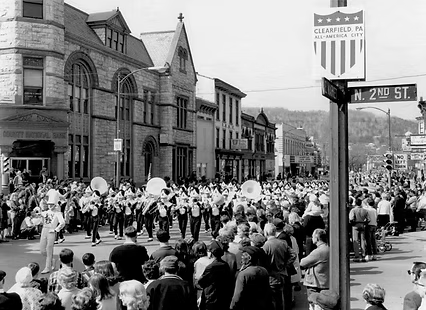
All-American City
Today
Revitalization Efforts
FROM CHINKLACAMOOSE TO CLEARFIELD
1797
Settlement Begins
1840
Borough Incorporated
1880’s
Coal Boom
1860-1890
Victorian Era
1966
All-American City
Today
Revitalization Efforts
A wilderness called Chinklacamoose
Before European settlers arrived, Native Americans knew this land as Chincleclamousche, surviving today as Chinklacamoose. The Ogdens built a gristmill along Moose Creek and planted an orchard, establishing the first permanent foothold in a landscape of dense forest and mountain ridges.
The community first took shape on land owned by Abraham Witmer of Lancaster County. He sold lots for between thirty and fifty dollars, though when the economic bottom fell out, they went for as little as a dollar fifty.
Timber, Coal and the Making of a Borough
Clearfield’s heavily wooded terrain made it a natural center for the lumber trade through the 1890s. By 1840, when the town was formally incorporated, it could boast a brick courthouse, an academy, a flouring mill, six churches, and a lumber mill. A bridge across the Susquehanna connected the borough to Bellefonte and Erie, opening trade in every direction.
The discovery of a rich coal vein in the 1880s reshaped the town again. Fine local clay supported a brick industry that eventually produced the firebricks powering Pittsburgh’s famous steel blast furnaces, a quiet connection between this small Pennsylvania borough and one of America’s great industrial cities.
A Center of Commerce and Leadership
As Clearfield grew more crowded and more commercial, large Victorian homes rose along Front Street. They belonged to Governor William Bigler, U.S. Senator William Wallace, Attorney Thomas Murray, and the Lee family, whose extensive coal and lumber interests made them among the most powerful families in the region.
The majority of these homes were constructed during Clearfield’s economic and political apex, between 1860 and 1890, when the community was a genuine powerhouse in Pennsylvania state politics. The architecture of Front Street still tells that story to anyone who looks closely enough.

Notable Residents
Govenor William Bigler
Governor of Pennsylvania
Senator William Wallace
U.S. Senator
Thomas Murray
Attorney
The Lee Family
Coal and lumber interests
Joseph & Elizabeth Shaw
Library founders and community benefactors